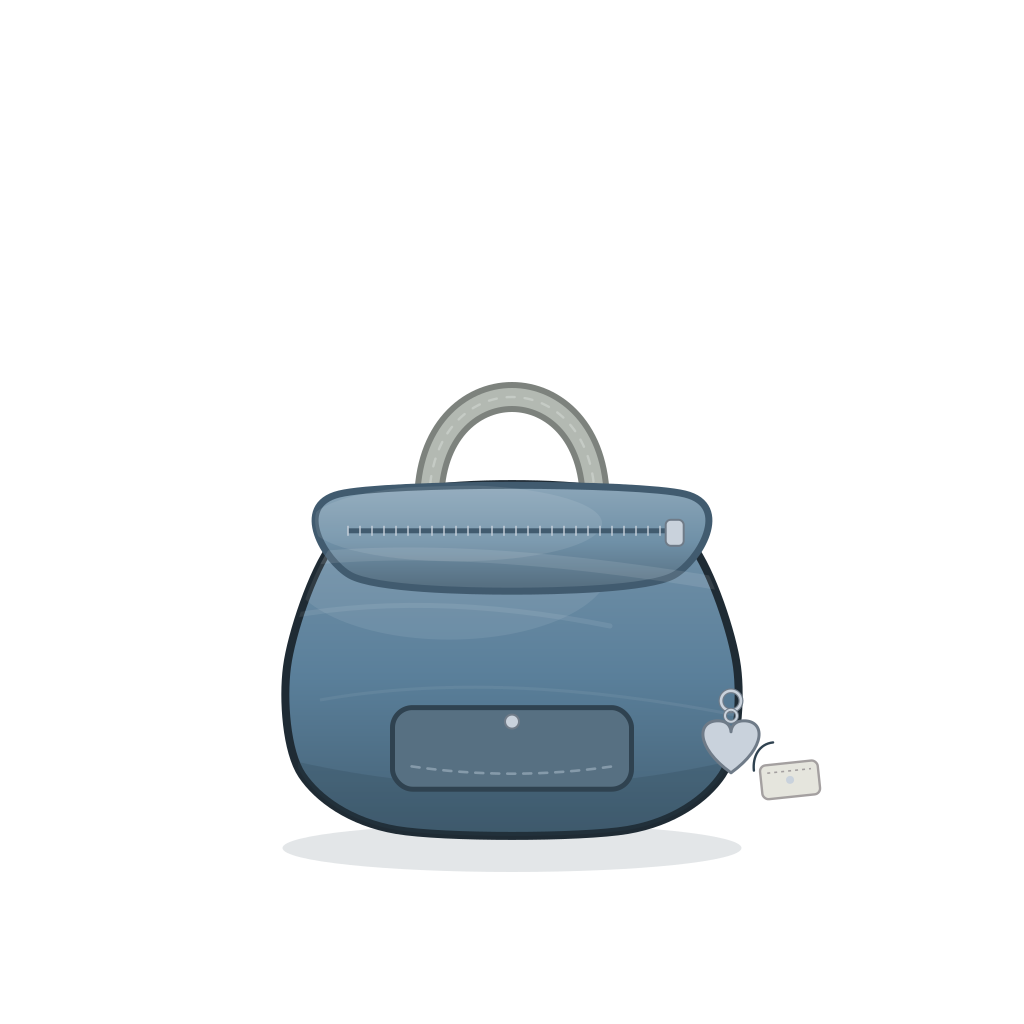
Tuck began as a way to cheat. During an early paper prototype, a charger would not fit anywhere, so we slid it under the laptop and pretended it was in the laptop bag. The board got smaller, the bag closed, and the puzzle suddenly had a second layer: not just where things go, but what can hold what.
That accidental rule became the most important verb in the game. A small item can nest inside a larger host and take up zero grid cells. A laptop can hold a charger. A jacket can hold a phone. A wallet can hold keys. Each host can hold one guest, and a tucked pair moves as one piece.
The first prototype was too clever
The earliest version let you tuck almost anything into anything, as long as the host was larger. It was technically satisfying and emotionally wrong. Players spent more time hunting for loopholes than packing the bag. The puzzle became a search for the most permissive host rather than a decision about what belongs together.
We narrowed the rule. Only certain pairs make sense, and those pairs are based on the small stories the game is telling: the charger that lives in the laptop sleeve, the phone that disappears into a jacket pocket, the keys that rattle around in a wallet. The restriction made the mechanic feel authored instead of arbitrary.
Show the glow, not the manual
The second problem was teaching. A rule that only works on specific pairs is hard to discover if the interface stays silent. We tried a tutorial card, then a help panel, then a small blinking arrow. All of them made the game feel like homework.
The answer was to let the drag do the talking. When you lift a small item over a valid host, the host glows gold and a tiny label shows the space it saves: +2 cells, +1 cell. If the pair is invalid, the bag stays quiet. Players learn the vocabulary by moving things, not by reading a list.
We also made the tucked item visibly disappear into the host. The host gets a small badge, and the pair travels together. That visual consequence does more than any tooltip: it tells you the item is still there, still part of the bag, just out of the way.
The interface should answer the question your hand is already asking.
Undo is part of the mechanic
A nesting puzzle invites experimentation, and experimentation needs a safety net. Undo had to be instant, unlimited, and visible. Reset had to be one tap away. The moment a player worries about ruining a layout, they stop playing with the bag and start playing defensively.
That is also why the game has no timer. The fun of Tuck is in the moment when a crowded bag suddenly has room. Rushing that moment would be like rushing a deep breath.
By the final prototype, the mechanic had a simple shape: pick up, hover, glow, tuck. No meter, no currency, no upgrade tree. Just a small physical idea that makes a bag feel bigger on the inside.